
Retaining Walls — Built & Repaired in Connecticut
Innovative Masonry & Restoration
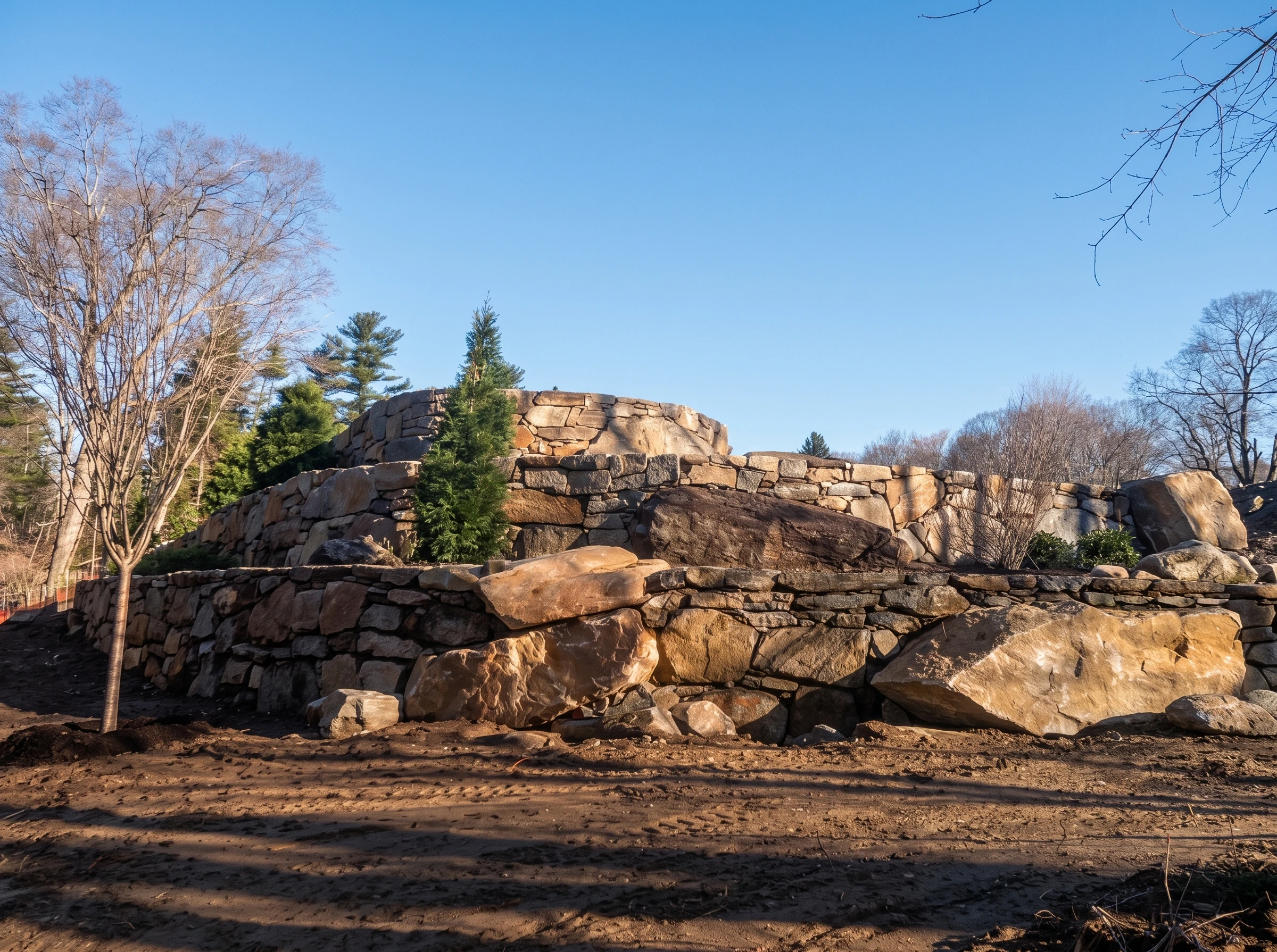
A well-built retaining wall holds back hillsides, defines yard levels, prevents erosion, and adds tens of thousands of dollars to your property's value. A poorly built one bows, leans, cracks, and collapses — usually within a few seasons. The difference is in the foundation, drainage, and material selection — none of which is visible from the outside.
Innovative Masonry & Restoration builds and repairs retaining walls of all sizes across Fairfield, New Haven, Hartford, Middlesex and Litchfield Counties — natural stone, segmental block, brick, and reinforced systems. Every wall is built with proper drainage and footings so it stays where we put it.
Types of Retaining Walls We Build
Natural Stone Retaining Walls
Mortared natural stone walls — bluestone, granite, fieldstone, or local New England stone — are the most attractive option for residential properties. They're more expensive than block but they last decades longer and they age beautifully. We build single-tier walls up to about 4' and multi-tier (terraced) walls for larger height requirements.
Dry-Stacked Fieldstone Walls
The traditional New England property wall — built without mortar using compression and friction. Properly dry-stacked walls last well over a century. We build new dry-laid walls and repair existing stone walls that have shifted, lost stones, or partially collapsed.
Segmental Block Retaining Walls
Engineered concrete retaining wall systems — Versa-Lok, Allan Block, Belgard, Techo-Bloc, and similar — designed specifically for retaining wall use. These systems are cost-effective, structurally engineered, and available in many styles. Good fit for walls 3'-8' in height.
Brick Retaining Walls
Mortared brick retaining walls work well for shorter walls (typically under 3') in formal or traditional landscape designs. Brick retaining walls require excellent drainage and proper expansion joints to prevent freeze damage.
What Makes a Retaining Wall Last (or Fail)
The most important parts of a retaining wall are the parts you can't see:
- Footing depth: The base of the wall must be below Connecticut's frost line — minimum 42" for permanent walls.
- Footing material: Compacted gravel base of proper depth, typically 6"-12" minimum.
- Drainage behind the wall: Drainage stone (clean crushed) and a perforated drain pipe at the base, with daylight outflow points.
- Backfill specification: Crushed stone backfill against the wall, not the native soil that creates hydrostatic pressure.
- Wall batter: The slight backward lean that helps the wall resist soil pressure.
- Geogrid reinforcement on taller walls: Required for any wall over 4' to anchor it back into the hillside.
If any of these are skipped or done poorly, the wall will fail — often dramatically — within a few winters.
Retaining Wall Repair
We repair existing retaining walls that are leaning, bowing, cracking, or losing stones. Common repairs:
- Resetting shifted stones on dry-laid walls.
- Repointing failed mortar on mortared walls.
- Rebuilding collapsed sections while preserving the surrounding wall.
- Adding drainage to walls that lack it (the most common cause of failure).
- Full rebuild when the wall has failed beyond repair, often using salvageable original stones.
Project: a failed wall rebuilt in natural stone
A hillside wall at a Connecticut home had given way, dropping stone and soil toward the property below. We removed what was left of it, cut the slope back, and rebuilt it by hand in natural stone — roughly ten feet tall at its highest, with drainage behind the face so water moves through the wall instead of pushing against it.
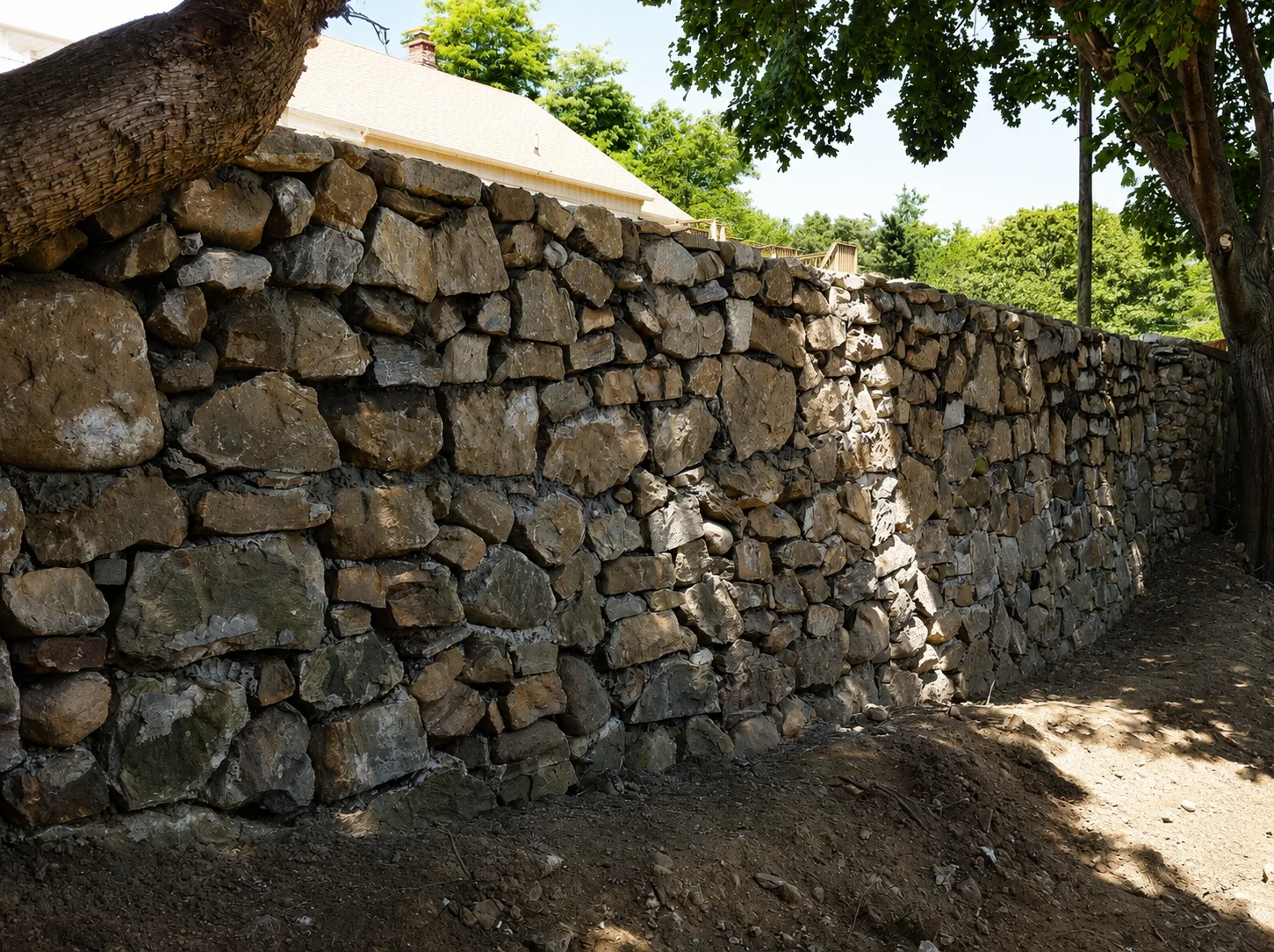 See the before, excavation and finished wall →
Tiered & Multi-Level Retaining Walls
For taller height requirements, multiple smaller terraces are usually better than one tall wall — both structurally and visually. Tiered walls let you create planted shelves, integrated steps, and a softer landscape transition. They're also cheaper to build than a single tall wall because each individual tier is shorter.
Drainage & Weep Holes
Every retaining wall we build includes proper drainage at the base. Mortared walls get weep holes — small drainage openings — at regular intervals along the bottom course. Dry-laid walls drain through the stone-to-stone gaps as long as the backfill is correct. Failure to drain a retaining wall is the #1 cause of failure in Connecticut.
Permits
Most CT towns require building permits for retaining walls over 4' (some over 3'). We handle the permit process for projects that need it, including stamped engineering when required.
Service Area
Retaining wall installation and repair across Fairfield, New Haven, Hartford, Middlesex and Litchfield Counties — including New Haven, Hamden, Madison, Guilford, Branford, Hartford, West Hartford, Glastonbury, Middletown, Durham, Cheshire, Wallingford, and surrounding towns.
Frequently Asked Questions
How much does a retaining wall cost in Connecticut?
Retaining wall cost depends heavily on material choice, height, drainage requirements, footing depth, soil conditions, and site access. Natural stone walls cost more than segmental block systems but last significantly longer. Walls over 4' typically require engineering and stamped drawings. The footing and drainage work — much of which is invisible — affects cost more than the visible wall material in many cases. We provide free written estimates after a site visit and discuss material options at different price points so you can make an informed choice for your specific project.
Do I need a permit for a retaining wall?
Most Connecticut towns require building permits for retaining walls over 4' tall (some require it over 3'). Walls in setback zones, near drainage easements, or that affect adjacent properties may also require permits regardless of height. We handle permitting for projects that require it.
How long does a retaining wall last?
A properly built retaining wall — with correct footings, drainage, and materials — lasts 50-100+ years for natural stone, 30-50 years for engineered block systems. The wall life is determined almost entirely by the foundation, drainage, and backfill quality, not the visible stone or block.
What's the best material for a retaining wall in CT?
It depends on height, budget, and aesthetics. For under 3' and a formal look — brick or block. For under 4' with a natural look — fieldstone or bluestone. For 4'-8' walls — segmental block systems or mortared natural stone with engineering. For walls over 8' — engineered systems with geogrid, often best designed by a structural engineer.
Can you repair my existing retaining wall instead of replacing it?
Most existing walls can be repaired if the foundation is sound. We reset shifted stones, repoint failed mortar, rebuild collapsed sections, and add drainage to walls that lack it. Replacement is only necessary when the underlying foundation has failed or the wall design itself is wrong for the conditions.
Why do retaining walls fail in Connecticut?
The two biggest causes: poor drainage (water saturates the soil behind the wall, freezes, and pushes the wall outward) and footings that don't reach below the frost line (frost heave lifts and tilts the wall every winter). Both are invisible from the outside, which is why many walls 'suddenly' fail after just a few years.
Local Service Areas
We work directly with homeowners and property owners in cities across our service area. For service-specific information by location:
Get a Retaining Wall Estimate