Paver Patios in Connecticut
Innovative Masonry & Restoration
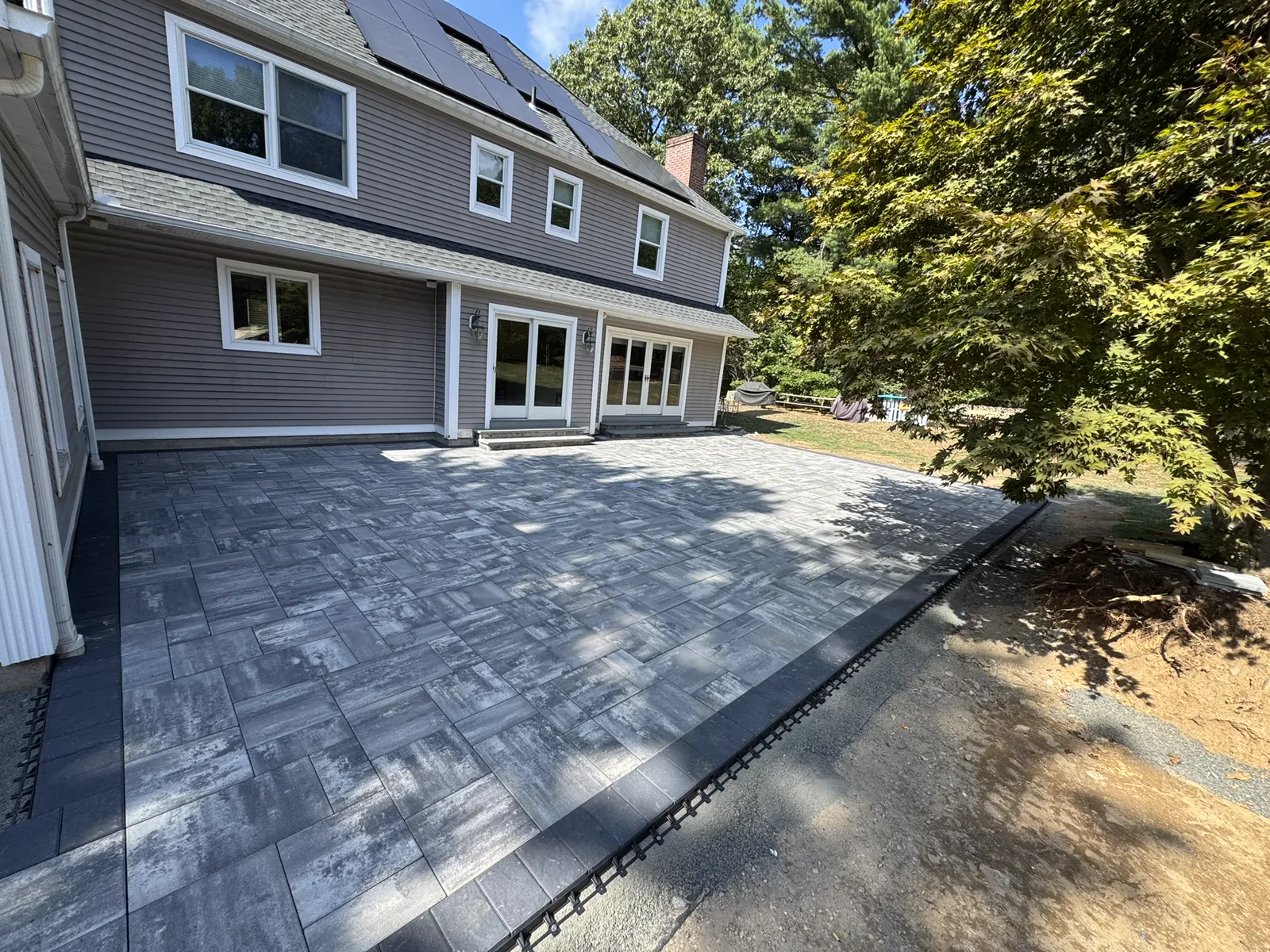
A well-built paver patio adds usable outdoor living space, increases your home's value, and lasts decades. A poorly built one settles, heaves with frost, drains into your foundation, or grows weeds through every joint within a year or two. The difference comes down to the base preparation — the part that nobody sees.
Innovative Masonry & Restoration designs and installs paver patios across Fairfield, New Haven, Hartford, Middlesex and Litchfield Counties. We do the base work right, so the patio you pay for is the one you have ten and twenty years from now.
Materials We Install
Concrete Pavers
Engineered concrete pavers from Belgard, Techo-Bloc, Cambridge, and Unilock — available in dozens of colors, textures, and patterns. Excellent durability, predictable color, wide range of styles. The most popular choice for new patio installations.
Natural Stone (Bluestone, Flagstone, Travertine)
Bluestone, irregular flagstone, and travertine give you a one-of-a-kind look. Each piece is unique, so the patio looks more naturally integrated with the landscape. More expensive than concrete pavers but unmatched in character. We install with mortared joints (formal) or sand-set (more casual).
Brick Pavers
Clay brick pavers are the traditional choice for New England homes — particularly colonials and historic properties. They develop a beautiful patina with age and complement traditional architecture better than any other material.
Our Patio Installation Process
1. Design & Layout
We start by understanding how you'll use the space — dining, lounging, fire pit area, grill area — and then design the layout to match. Patio shape, drainage direction, traffic patterns, and integration with existing landscape are all considered up front.
2. Excavation
We dig out 8-12" of native soil depending on the patio's intended use and soil conditions. Patios in poorly drained soil need deeper excavation. Patios that will hold heavy loads (a hot tub, for example) need additional reinforcement.
3. Base Preparation
The most important step. We install 6-10" of compacted process gravel (3/4" minus or 1.5" minus, depending on application), compacted in 2-3" lifts with a plate compactor. Each lift is fully compacted before the next is added. This is the work that determines whether the patio settles or stays flat.
4. Bedding Layer
1" of clean concrete sand on top of the compacted base, screeded flat. Pavers are set on this bedding sand — never directly on gravel.
5. Paver Installation
Pavers laid in the chosen pattern, edges cut to fit, with proper joint spacing. Edge restraint is installed along the perimeter to prevent pavers from spreading over time.
6. Joint Sand & Compaction
Polymeric joint sand swept into the joints, then activated with water. The polymeric binder hardens to lock pavers together while still allowing drainage. Final pass with the compactor to seat everything.
Multi-Level & Integrated Features
Patios don't need to be a single flat rectangle. We build multi-level patios with integrated retaining walls and steps, fire pit pads, seating walls, integrated lighting, outdoor kitchen pads, and pergola/pavilion footings. Multi-level designs are particularly effective on sloping yards where a single-level patio would require excessive grading.
Patio Drainage
Every patio we build slopes away from the house at a minimum of 1/4" per foot. We integrate drainage where needed — French drains, channel drains, dry wells — so water from the patio doesn't flow toward the foundation or pool in low spots.
Fixing Failed Paver Patios
If you have an existing paver patio that's settling, heaving, growing weeds, or has separating pavers — we can fix it. Most patio problems trace back to base preparation, but we've seen all the variations and can usually rehabilitate an existing patio rather than fully rebuild it.
Service Area
Paver patio installation across Fairfield, New Haven, Hartford, Middlesex and Litchfield Counties — including New Haven, Hamden, Madison, Guilford, Branford, North Haven, Hartford, West Hartford, Avon, Glastonbury, Middletown, Durham, Cheshire, Wallingford, and surrounding towns.
Frequently Asked Questions
How much does a paver patio cost in Connecticut?
Paver patio cost depends on material choice (concrete pavers, bluestone, flagstone, brick), patio size and shape, base preparation requirements, drainage needs, integration with retaining walls or steps, and access for materials and equipment. Multi-level designs and integrated features (fire pit pads, seating walls, lighting) all affect total cost. The base preparation — which is invisible once the patio is finished — is one of the biggest cost drivers and the single most important factor in long-term durability. We provide free written estimates after a site visit.
How long does a paver patio last?
A properly installed paver patio with correct base preparation lasts 30-50+ years. Individual pavers can be replaced if damaged. The base is what determines patio longevity — patios with poor base preparation (which is most DIY and cheap-contractor patios) often need significant rework within 3-5 years.
Are pavers better than stamped concrete?
For most homeowners, yes. Pavers don't crack — if a paver is damaged, you replace just that paver. Stamped concrete eventually cracks, and the cracks are visible across the entire surface. Pavers also have better freeze-thaw resistance and don't need regular sealing/recoloring like stamped concrete does.
How do I keep weeds out of my patio joints?
Polymeric joint sand — installed at the time of construction — hardens to a flexible binder that prevents most weed growth and keeps the joints stable. It does require periodic refreshing every 5-10 years. We use polymeric sand on every patio installation.
Can I add a fire pit or outdoor kitchen later?
Yes, but it's much easier and cheaper to plan for those features at the time of original installation. Adding a heavy structure like an outdoor kitchen or large fire pit later may require localized base reinforcement. We strongly recommend planning all future features into the initial design phase.
Do you install patios near pools?
Yes — pool surrounds are a common patio application. We use slip-resistant pavers, design proper drainage away from the pool, and coordinate with pool contractors when needed. Different pool types (gunite, vinyl, fiberglass) have different requirements at the patio interface.
How do you fix sunken pavers that hold water?
Sunken pavers are usually a base preparation issue — the gravel base under that section either was not compacted properly during installation or has eroded over time. We lift the affected pavers, excavate to the base, re-prepare the base properly with compacted gravel, re-bed the pavers in fresh sand, and reset them. Spot repair is much cheaper than rebuilding the whole patio — and addresses the actual problem rather than just leveling the surface.