
Paver Walkways in Connecticut
Innovative Masonry & Restoration
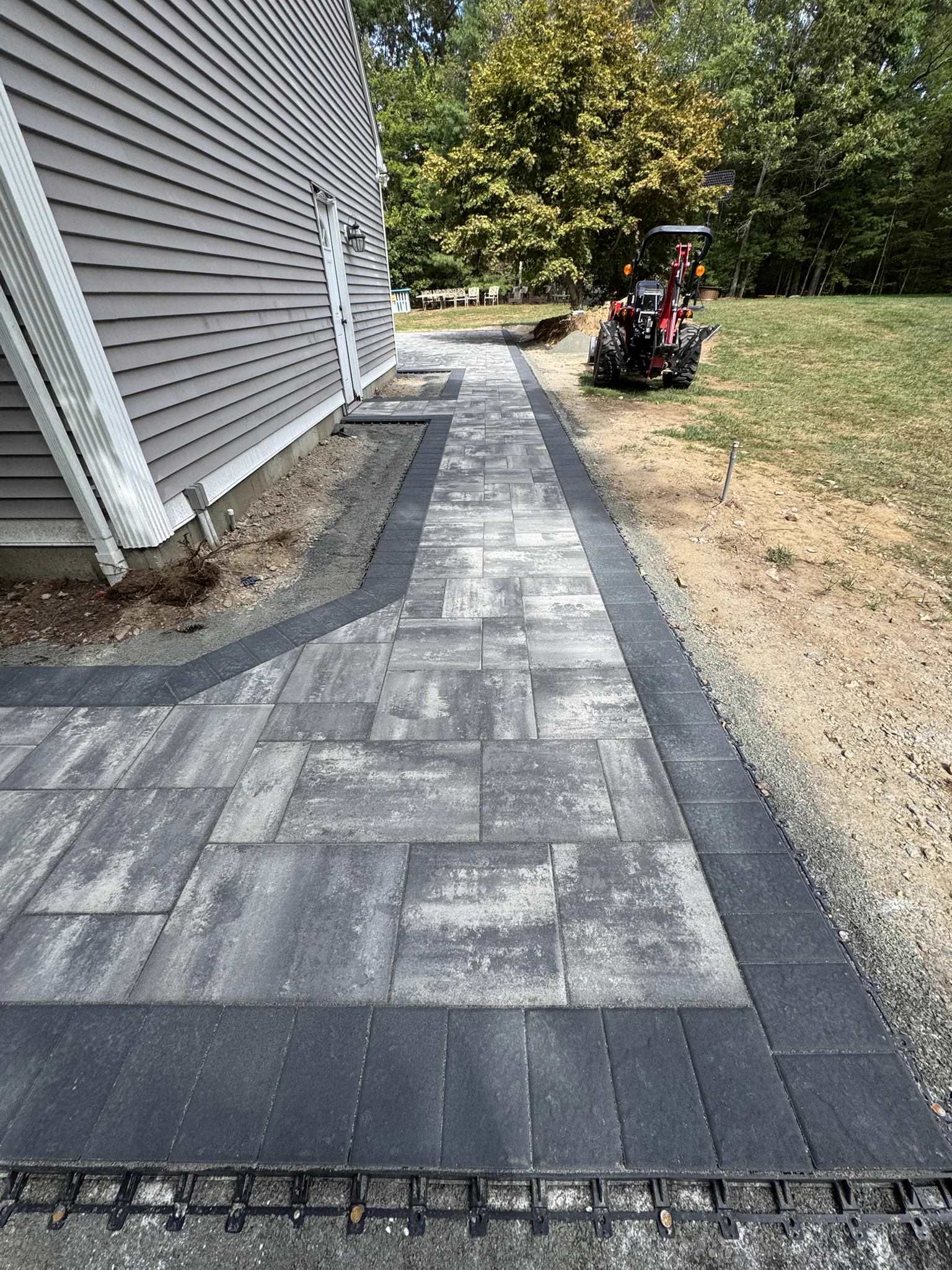
The walkway from your driveway or street to your front door is the first thing visitors see — and the first thing you walk over every day. A worn, cracked, or uneven walkway drags down everything else about your home's exterior. A well-built paver walkway transforms the entrance and lasts decades.
Innovative Masonry & Restoration installs custom paver walkways throughout Fairfield, New Haven, Hartford, Middlesex and Litchfield Counties — using concrete pavers, natural stone, brick, and flagstone. We design and build walkways that complement your home's style and hold up to Connecticut's freeze-thaw cycles.
Walkway Materials
Concrete Pavers
Engineered concrete pavers from Belgard, Techo-Bloc, Cambridge, and Unilock — available in many colors, sizes, and patterns. Most cost-effective and most consistent in appearance. Good fit for contemporary homes and predictable budgets.
Bluestone Walkways
Connecticut's classic walkway material. Available as thermal-finish (uniform sawn edges) or natural cleft (irregular edges and surface), and in dimensional sizes or irregular shapes. Bluestone develops a beautiful gray patina over decades and complements traditional New England homes perfectly.
Brick Walkways
Brick paver walkways are the right choice for colonial and historic homes. Common patterns include herringbone, basket weave, and running bond. Brick walkways age beautifully and complement traditional architecture better than any other material.
Flagstone Walkways
Irregular natural stone laid out either with mortared joints (formal) or as stepping stones in turf or gravel (informal garden path). Each piece is unique, giving the walkway a one-of-a-kind appearance.
Walkway Styles & Layouts
- Straight walkways — Direct paths from driveway or street to entry door. Most efficient and lowest cost.
- Curved walkways — Soft S-curves that complement landscape design and slow the visitor's approach. Costs slightly more in cuts and fitting but adds significant character.
- Wide entry walkways — 5-6' wide walkways for grand front entries.
- Stepping-stone garden paths — Individual stones set in turf, gravel, or groundcover. Best for informal back-yard garden access.
- Walkways with integrated lighting — Low-voltage path lighting integrated during installation.
- Walkways with steps — Single steps or short stair runs where grade changes require them.
Our Walkway Installation Process
1. Design & Layout
We mark out the walkway path and confirm width, materials, pattern, and any integrated steps before excavation begins. Final layout is approved on-site so you see exactly what you're getting.
2. Excavation
We excavate 8-10" deep along the walkway path — deeper than many contractors do, but necessary for a walkway that doesn't heave with frost.
3. Base Preparation
6-8" of compacted process gravel installed in 2-3" lifts, each lift compacted with a plate compactor before the next is added. This is the difference between a walkway that lasts and one that fails.
4. Bedding Layer
1" of clean concrete sand, screeded flat across the prepared base.
5. Paver or Stone Installation
Pavers or stones laid in the chosen pattern, with proper joint spacing. Edge restraints installed along both sides of the walkway to prevent spreading over time. All edge cuts done with a wet saw for clean, accurate fitting.
6. Joint Sand & Final Compaction
Polymeric joint sand swept into joints and activated with water — locking the pavers together while still allowing drainage. Final pass with the compactor seats everything.
Walkways with Steps
When the grade between two points changes by more than a few inches, steps are usually the right answer. We integrate single steps and stair runs into walkway designs using either matching paver materials, contrasting natural stone, or pre-cast concrete step systems. Step risers are designed for safe, comfortable walking — typically 6"-7" rise with 12"-14" tread.
Walkway Repair
If you have an existing walkway that's heaving, settling, or has individual broken or shifted pavers — we can repair it. Localized failures (a few sunken pavers, a small heaved area) can usually be fixed by lifting the affected pavers, correcting the base, and resetting. Whole-walkway failures usually require rebuilding the base.
Service Area
Paver walkway installation throughout Fairfield, New Haven, Hartford, Middlesex and Litchfield Counties — including New Haven, Hamden, Madison, Guilford, Branford, Hartford, West Hartford, Glastonbury, Middletown, Durham, Cheshire, Wallingford, and surrounding towns.
Frequently Asked Questions
How much does a paver walkway cost?
Paver walkway cost depends on material choice (concrete pavers, bluestone, flagstone, brick), walkway length and width, layout complexity (curved versus straight), base preparation requirements, integrated steps or grade transitions, and edge treatments. Natural stone walkways cost more than concrete paver walkways but provide a higher-end appearance and unmatched longevity. The base preparation — proper depth and compaction — is invisible once finished but determines whether the walkway lasts decades or starts failing in a few seasons. We provide free written estimates after a site visit.
How wide should my walkway be?
Front entry walkways are typically 4-5' wide — wide enough for two people to walk side-by-side comfortably. Garden paths can be narrower, 2.5-3' for stepping stones or 3-4' for solid paver paths. Side-yard utility walkways are usually 3' wide minimum.
Can a walkway be added to match an existing patio?
Yes — we frequently install walkways using the same paver line and color as an existing patio so the two flow together visually. As long as the original paver is still in production, color and style matching is straightforward.
How long does a paver walkway last?
A properly installed paver walkway lasts 30-50+ years. Individual pavers can be replaced if damaged. The base preparation is what determines longevity — walkways with poor base prep often start heaving or settling within 2-3 winters.
What's the best walkway material for a colonial home?
Brick or bluestone — both have over 200 years of history in New England and complement colonial architecture better than any modern material. Bluestone (especially natural cleft) is slightly more formal; brick (especially in herringbone or basket weave) is slightly more traditional.
Do paver walkways get slippery in winter?
Pavers are less slippery than smooth poured concrete in icy conditions because the joints provide grip. For walkways with consistent ice exposure (north-facing entries, shaded paths), we recommend textured paver finishes or natural cleft stone for additional traction.