
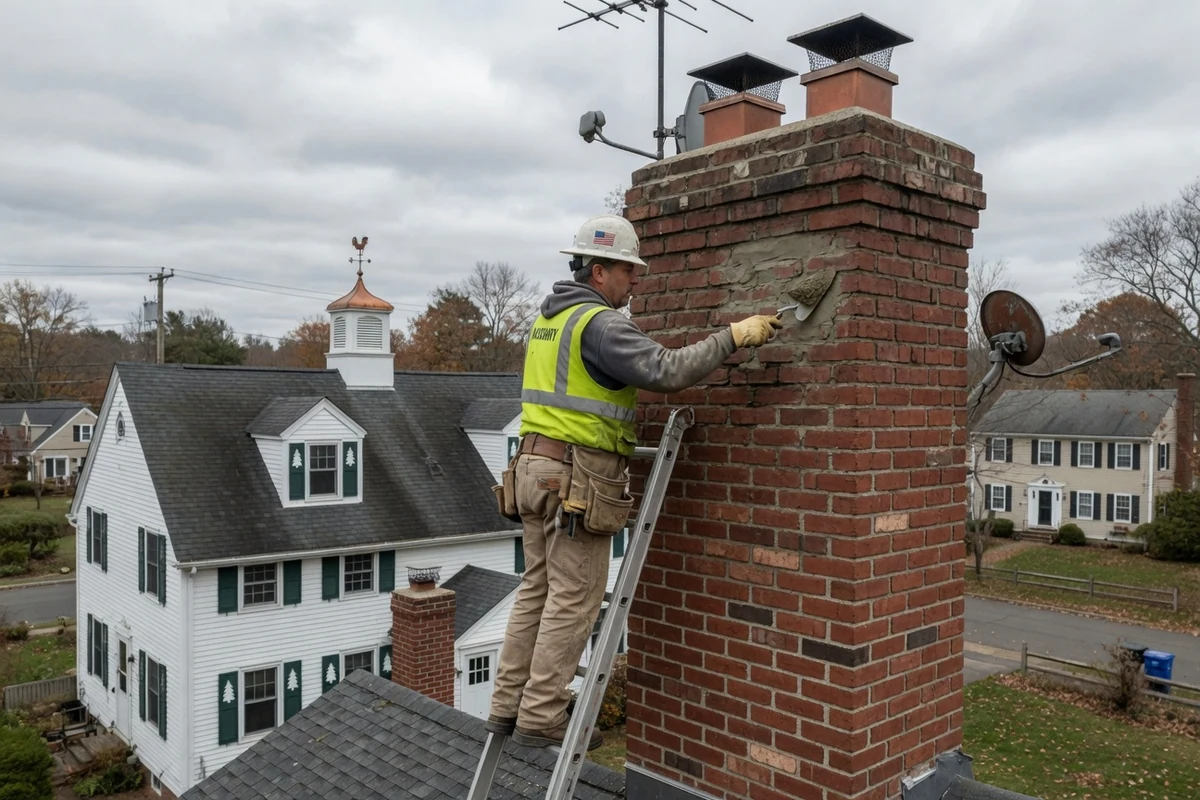
The terms "chimney crown" and "chimney cap" sound similar and homeowners often use them interchangeably — but they are actually two different things, doing two different jobs. Knowing the difference matters when you are getting estimates or trying to diagnose a chimney problem.
The Chimney Crown
The crown is the concrete or mortar cap that covers the entire top surface of the chimney structure. It is part of the chimney itself, formed from poured concrete or masonry mortar, and it slopes outward to shed water away from the chimney brick.
The crown's job is to protect the masonry of the chimney from rain. Without a properly built crown, water sits on top of the brick, soaks into the joints, and freeze-thaw damage progresses rapidly.
Crown Components
- Concrete or mortar surface — typically 2-4" thick at the center, sloping outward.
- Drip edge — overhang at the perimeter that lets water drip away from the brick rather than running down the chimney face.
- Isolation joint around the flue tile — a small gap (often filled with a flexible sealant) that lets the flue tile expand independently of the crown without cracking it.
Common Crown Problems
- Hairline cracks (minor — can usually be sealed).
- Wide cracks across the surface (water actively entering the chimney).
- Spalling concrete (chunks breaking away).
- No drip edge (water runs down the chimney face accelerating brick deterioration).
- No isolation joint (flue tile expansion has cracked the crown).
- Missing entirely (just mortar between the brick courses, common on older chimneys).
The Chimney Cap
The cap is the metal cover that sits on top of the flue opening (the round or square hole through the crown that the smoke goes up). It is a separate piece of hardware, usually stainless steel or copper, with screen sides that let smoke out while keeping rain, leaves, and animals from going in.
Cap Components
- Top cover — keeps rain out of the flue.
- Screen sides — prevent animals (squirrels, raccoons, birds) from entering.
- Spark arrestor function — the screen also catches sparks before they reach the roof, which is required by code in many CT towns.
- Mounting attachment — usually clamps onto the flue tile or bolts to a top mount.
Common Cap Problems
- Missing entirely (rain enters the flue, animals get in).
- Rusted out (cheap caps fail in 5-10 years).
- Damaged by weather, falling tree branches, or animal activity.
- Wrong size (loose fit or undersized for the flue opening).
Side-by-Side Summary
| Feature | Crown | Cap |
|---|---|---|
| Material | Concrete or mortar | Stainless steel, copper, or galvanized metal |
| Position | Top surface of chimney brick | On top of the flue opening |
| Job | Protect the brick from water | Keep rain and animals out of the flue |
| Lifespan | 20-30+ years if properly built | 15-25 years for stainless; 5-10 for cheap galvanized |
You Need Both
A chimney with no cap collects rain in the flue, leading to interior chimney damage, animal nesting, and potential creosote moisture issues. A chimney with no crown — or a failed crown — soaks the brick from above, causing accelerated spalling and mortar failure. Both components matter, and both should be in good condition.
When to Call a Professional
If you are looking up at your chimney from the ground and seeing visible damage at the top, it could be a crown problem, a cap problem, or both. They look similar from below but require different repairs. We assess crown and cap condition during any chimney inspection and provide a written estimate covering whatever repair is actually needed. View our chimney repair services →
Get a Chimney Inspection
We assess crown condition, cap condition, brick, mortar, and flashing — then provide a written estimate.
Schedule a Chimney Assessment